Curriculum VITA
Book I’m most proud of:
Parsons, M. J. (1987). How we Understand Art: A Cognitive Developmental Account of Aesthetic Experience, New York, NY: Cambridge University Press. Translated and published in Portuguese, Spanish and Japanese.
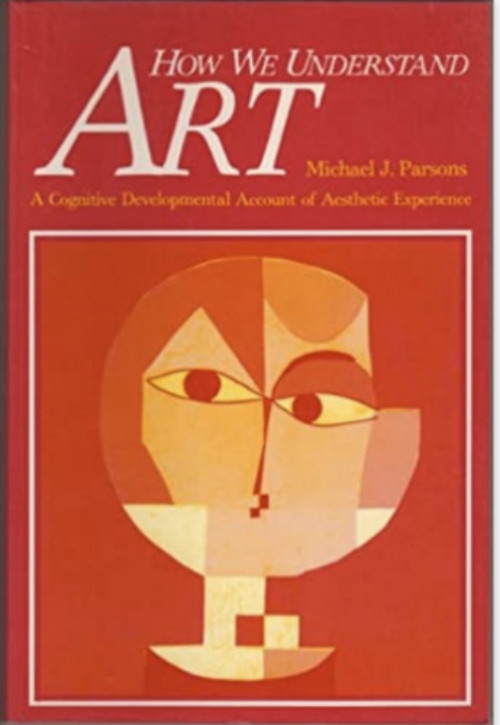
How We Understand Art was written during the period when Modernism was slowly changing into what is often called Postmodernism. It was an attempt to explore the consequences of this change for our notions of how children respond to art. It offered a developmental account, agreeing with Dewey, Piaget, and Laurence Kohlberg, that children much construct their own account of important matters (people, science, morality) for themselves. The work of Kohlberg was particularly influential on it.
For eight years I researched the responses of a range of school children in Salt Lake City, where I taught at University of Utah, trying to track the way they thought about artworks. I looked for their understanding of a small range of works – popular reproductions that were easy to get at the time. (I could not get a research grant for this at that time.) For further discussion read more HERE.
Reviews of this book:
- DiBlaso , M. K. (1988). Educational Application of “How We Understand Art”: An Analysis. Journal of Aesthetic Education, 22(4), 103-107.
- Dixon, R. (1989). How We Understand Art. A Cognitive Developmental Account of Aesthetic Experience by Michael Parsons. Leonardo, 22(1), 133-134.
- Winner, E. & Gardner, H. (1988). Review of How We Understand Art. Human Development,31(4), 256-260.
- Pariser, D. (1988). Review of Michael Parsons’ “How We Understand Art”. Journal of Aesthetic Education, 22(4), 93-103.
- My response to Pariser’s review: Parsons, M. (Winter, 1988). Assumptions about Art and Artworld: A Response to Critics. The Journal of Aesthetic Education, 22(4), p. 107-116.
Parsons, M. J., & Blocker, G. (Eds.) (1993). Aesthetics and Education. University of Illinois Press. Translated and published in Chinese, 1997.
In the 1990s, the Getty Foundation for Art education was actively promoting its Discipline Based Art Education program in American schools. One effort was to publish books for teachers about each discipline. H. Gene Blocker and I were asked to write this one on teaching aesthetics in school. Our approach was to introduce some common problems in the philosophy of art – what is beauty and ugliness? Is realism a valuable criterion? Do artists express their own emotions? Do artworks from other cultures change their meaning when they change their context? – and encourage teachers and school children to discuss them to form their own opinions. There are many examples of such discussions and the book was widely distributed. I believe Getty had it translated and published in China.
Earliest book
Broudy, H. S., Parsons, M. J., Snook, Ivan A., & Szoke, R. D. (1967). The Organization of a Field (An essay review): Philosophy of Education: An Organization of Topics and Selected Sources. Champaign, IL University of Illinois Press.
Harry Broudy, senior professor at the University of Illinois, persuaded the U.S Office of Education to fund a four-year grant to identify the literature of the philosophy of education and to organize it. This book is the outcome of that project. Broudy hired four of his graduate students as his assistants to identify, read, summarize and help organize the existing literature according to the problems it addressed; but there can be no doubt that he was more than just ‘the senior author.’ Read more
Review of this book: Robert Ulich (1969). The Organization of a Field: (AN ESSAY REVIEW). The Educational Forum, 33:2, 247-250, DOI: 10.1080/0013172690933885
PUBLICATIONS
Book Chapters
Lakoff and Johnson’s book about metaphors, which argues that, rather than being a “linguistic trope,” they are a fundamental structure with which we create new meanings has been widely persuasive, based as it is on embodiment views in psychology. The idea is that we establish patterns of neural connection as we grow and later use those patterns to understand new meanings. Lakoff and Johnson give many examples (eg., I grasp your meaning). But all of their examples are linguistic ones, although it seems clear that metaphors may also work in other medium – such as dance, theatre. In this chapter I introduce the idea of metaphors in the visual arts and discuss a number of examples from contemporary artworks. One example is apartment towers are like birdcages, a work by Kum Chi Keung in Hong Kong. In discussing this case, I argue that visual metaphors can be read backwards as well as forwards and that their interpretation is influenced by the culture of the viewer and of the artist. I discuss a number of other examples of metaphors in visual artworks.
- Parsons, M. (2004) Art and integrated curriculum. In D. Eisner and M. Day (Eds.)., Handbook of Research and Policy in Art Education (pp. 775-794). Mahwah, NJ: Erlbaum. Reprinted as “Arte e cognicao integrados,” in Arte Educacao Contemporanea (2006), A. Barbosa & C. Paulo (Eds).
- Parsons, M. J. (1999). A PDS network of teachers: The case of art. In Johnston, M., Brosnan, P., Cramer, D., & Dove, T. (Eds.), Collaborative Reform and Other Improbable Dreams (pp. 223-231). New York, NY: State University of New York Press.
- Parsons, M. J. (1999). On the development of understanding art. In Ralph Mosher (Ed.). Human Development Across the Life span (pp 71-87). Westport, CT. Praeger Press.
- Parsons, M. J. (1991). Stages of aesthetic development. In R. A. Smith & A. Simpson (Eds.), Aesthetics and arts education (367-372). Urbana & Chicago, IL: University of Illinois.
- Parsons, M., & Johnston, M. (1986). Ugliness and expression: Two reactions to Ida. In M. Ross, (Ed.), Curriculum Issues in Arts Education (pp. 155-164). London: Pergamon Press.
- Parsons, M., Johnston, M., & Durham, R. (1979). A cognitive developmental approach to aesthetic experience. In R. L. Mosher, (Ed.), Adolescents’ Development and Education: A Janus Knot (pp. 209-235). Berkeley: McCutchen Publishing.
- Parsons, M., Johnston, M., &* Durham, R. (1979. A cognitive developmental approach to aesthetic experience. In R. L. Mosher, (Ed.), Adolescents’ development and education: A Janus know 9pp. 209-235). Berkeley: McCutchen Publishing.
- Parsons, M. J. (1971). Herbert Read on education. In R. Smith (Ed.), Aesthetics and problems of education (pp. 42-63). University of Illinois Press.
Journal Articles
- Parsons, M. J. (Agosto 2014). Visual metaphors: Meaning, interpretation and culture. Revista GE Arte, 1(2), 235-247.
- Parsons, M. J. (Summer 2005). Art and Cognition: Integrating the visual arts in the Curriculum. Studies in Art Education, 46(4), 369-377.
- Parsons, M. J. (1992). Cognition as interpretation in art education. The arts, education, and aesthetic knowing, 91, 70-91.
- Parsons, M. J. (1969). Herbert Read on education. Journal of Aesthetic Education, 13(4), 27-45. Reprinted In R. Smith (Ed.), Aesthetics and problems of education (pp. 42-63). University of Illinois Press.
Book Reviews:
Essay review. The partisan and the historian (1988). Higher Education Review, 20(3), 83-87. Review of Culture Wars: School and Society in the Conservative Restoration, 1969-1984 by Ira Shor (1986). New York: Routledge and Kegan Paul.
Review. (Autumn 1983). The Journal of Aesthetics and Art Criticism, 42(1), 89-90. Review of The Work of Artists by V. A. Howard (1982). New York: Wiley Publishers on behalf of The American Society for Aesthetics.
Review (Autumn 1981). The Journal of Aesthetics and Art Criticism, 40(1), 107-108. Review of Symbolic Functioning in Childhood by N. R. Smith and M. B. Franklin, (1979). East Sussex, UK: Psychology Press.
Review. (1981) Philosophy of Education, Educational Studies 14(1), 43-46. Review of The Philosophy of Schooling by Robin Barrow (1981). New York: Halsted Press.
Essay review. (1981). Studies in Art Education, 4(1), 80-91. Review of Child Development in Art by A. Kindler, 1997. New York: National Association of Art Education.
Review (Winter, 1981). Journal of Aesthetic Education, pp. 234-23. Review of The Teaching Process and Arts and Aesthetics by G. L. Knieter and J. Stallings, (eds.), 1979. St. Louis: CEMREL, Inc.
Review (Autumn 1977). The Journal of Aesthetics and Art Criticism, 36(1), 98-100. Review. The Arts, Human Development and Education by Elliot Eisner, 1976. Berkeley, California: McCutchan.
Review (1976). Journal of Aesthetic Education 10(1), 122-124. Review of Teacher as Stranger: Educational Philosophy for the Modern Age by Maxine Greene, 1973. New York: Teachers College Press.
Review (April 1974). The Journal of Aesthetic Education, 8(2), 107-109. Review of Man and His Circumstances: Ortega as Educators by Robert McClintock, 1973. New York: Teachers College Press..
Essay Review (1973). The skills of appreciation. The Journal of Aesthetic Education, 7(1), 75-82. Review of The Art of Appreciation by Harold Osborne., 1970. Oxford: Oxford University Press.
Review (April 1971). The Journal of Aesthetic Education, 5(2), 149-151. Review of Media Sociology: A Reader by Jeremy Tunstall, 1970.. UK: Constable Publisher.
Review (October 1971). The Journal of Aesthetic Education, 5(4), 166-167. Review of The Ways of Meaning in the Arts by G. P. Stein (1970). London, UK: Humanities Press.
Essay Review (1969). Astronauts and Admen. Educational Theory, 2(1), 112-116. Review of The feminized male by P. Sexton, 1969. New York, Random House.
Essay Review (1969). The Journal of Aesthetic Education, 373-378. Review of Expectations and learning: Philosophy of education by Donald Arnstine, 1967. New York: Harper and Row.
Essay review (January 1969). Educational Theory 19(1), 99-107. Review of An introduction to the Analysis of Educational Concepts by J. F. Soltis, 1978, MA: Addison Wesley Publishing Company.
 Michael John Parsons' Academic Webpage